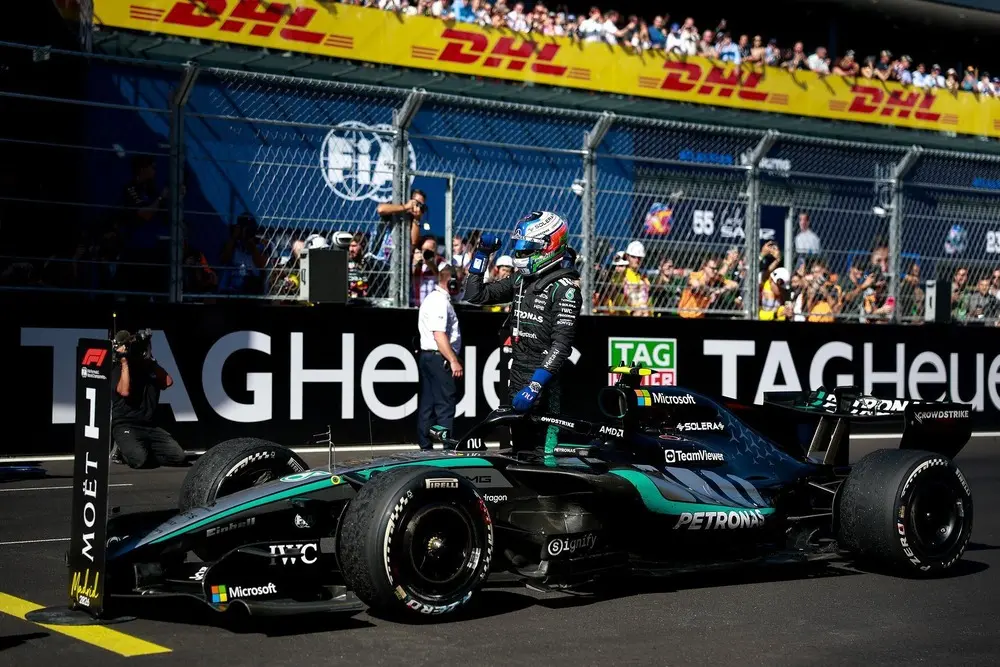


The controversial Mercedes F1 engine compression loophole is believed to deliver an extra 10-15 horsepower which translates to 0.3-second advantage per lap.
The Silver Arrows and potentially Red Bull appear to have exploited a technical nuance in the new 2026 F1 power unit regulations, raising concerns among rival manufacturers who have called on the FIA to intervene.
Under the new rules, engines will have maximum geometric compression ratio slashed from 18:1 under the previous hybrid V6 era to a stricter 16:1, aimed at balancing power outputs, enhancing sustainability through increased electric boost reliance, and leveling the playing field among manufacturers.
At its core, the loophole revolves around how the FIA mandates measurement of this ratio, outlined in Technical Regulations Document 042 which mandates checks on stationary engines at ambient garage temperatures.
Mercedes’ trick reportedly leverages thermal expansion properties of precision-engineered components, ensuring the engine registers precisely 16:1 at ambient temperature during static FIA homologation checks.
Once fired up and operating under racing conditions—where temperatures soar to extremes within cylinders exceeding 2,000 degrees Celsius—these components expand differentially.
Paddock whispers amplified by German publication Auto Motor und Sport suggest Mercedes engineers employed advanced 3D printing to craft pistons with tailored thermal behaviors, elevating the effective ratio to around 17:1 or even approaching the old 18:1 benchmark during dynamic operation.
This is rooted in metallurgy and thermodynamics where materials like specialized aluminum alloys or ceramic-infused composites swell at rates calibrated to shrink clearance volumes precisely when heat is generated, amplifying combustion pressure without changing the cold-state geometry that regulators probe.
Further sophistication comes via an alleged auxiliary volume system: a minuscule one-cubic-centimeter pocket linked to the combustion chamber through a narrow channel adjacent to the pre-chamber spark plug.
Mercedes engine loophole sparks uproar as rivals propose F1 rule change for Australian GP
Explained: Two 2026 F1 engine rules loopholes shut down by FIA
In static tests, this pocket integrates into the cylinder volume as the piston cycles, dutifully contributing to the 16:1 reading.
Under load, however, elevated pressures and temperatures create a threshold effect—the channel’s resistance prevents the pocket’s volume from participating fully in compression, effectively reducing the denominator and boosting F1 engine compression ratio.
This mechanism mirrors variable compression technologies seen in road cars, like Infiniti’s VC-Turbo, but hyper-optimized for F1’s brutal demands where millisecond ignitions and fuel-flow caps demand flawless execution.
Rival manufacturers decry Mercedes F1 engine compression loophole as a “clever trick,” estimating a performance gain of 10-15 horsepower which translates to 0.2-0.3 seconds per lap on power-sensitive circuits like Monza or Spa—enough to swing championships in a parity-driven era.
Ferrari, Honda, and Audi—representing customer teams like Haas and Aston Martin—penned urgent letters to the FIA, demanding clarity and closure before the 2026 Formula 1 season opener in Australia coming in a month’s time.
Red Bull is reported to have sided with the majority despite using a similar trick to increase F1 engine compression ratio, but the gains were considerably smaller compared to those of Mercedes.
Mercedes team principal Toto Wolff has however dismissed rival complaints as distractions, and maintained their engine is fully compliant with the new 2026 F1 power unit regulations.
READ MORE:
Key 2026 F1 regulations changes explained: Comprehensive guide to Formula 1’s new era