
Formula 1 is set to open a new chapter in the 2026 season with targeted, mid‑season rule changes that sharpen the balance between safety, spectacle and technological challenge.
Following a key stakeholders’ meeting on April 19–20 ahead of the Miami Grand Prix, the FIA confirmed a package of adjustments focused on energy management in qualifying, a new safety‑oriented system for race starts, and upgraded wet‑weather protocols.
These tweaks do not overhaul the 2026 F1 regulations but instead fine‑tune what has already proven to be occasionally unintuitive set of systems, ensuring that the new cars remain exciting, competitive and secure for drivers.
We unpack each confirmed adjustment, explaining its technical background and impact on on‑track strategy.
2026 F1 Rule Changes: Energy Management in Qualifying
At the heart of the April meeting was a decision to recalibrate how much energy power units can harvest and deploy in qualifying, with the aim of making the sessions feel more “pure.”
The FIA, teams and engine manufacturers agreed to reduce the maximum energy recharge limit per lap from 8 megajoules (MJ) to 7 MJ, effectively tightening the window for drivers to harvest energy on the straights while still allowing enough flexibility to manage their power–tyre balance.
This change is intended to curb the creeping trend of drivers lifting‑off or “super‑clipping” early in the lap purely to meet energy‑target constraints.
Lowering the recharge cap will encourage drivers to spend more of their lap closer to full throttle, rewarding outright speed and late‑braking aggression rather than the most sophisticated energy‑saving algorithm.

Complementing this adjustment is a tweak to the “super‑clipping” recharge allowance, which has been raised to 350 kW for “key acceleration zones”, but will be limited to 250 kilowatts for other parts of the lap.
Additionally, the maximum power available through the Boost is now capped at +150 kW, “or the car’s current power level at activation if higher”.
These tweaks aim to limit sudden performance differentials between drivers on track, avoiding high speed incidents similar to Oliver Bearman’s crash in Suzuka.
Race‑Start Safety System: New Protocols and Driver Alerts
Even as the 2026 cars dazzled in pre‑season testing, teams and drivers voiced concerns about the intensity of race starts, particularly around the use of “straight‑mode” power delivery and the risk of extreme closing speeds when cars run out of stored energy down straights.
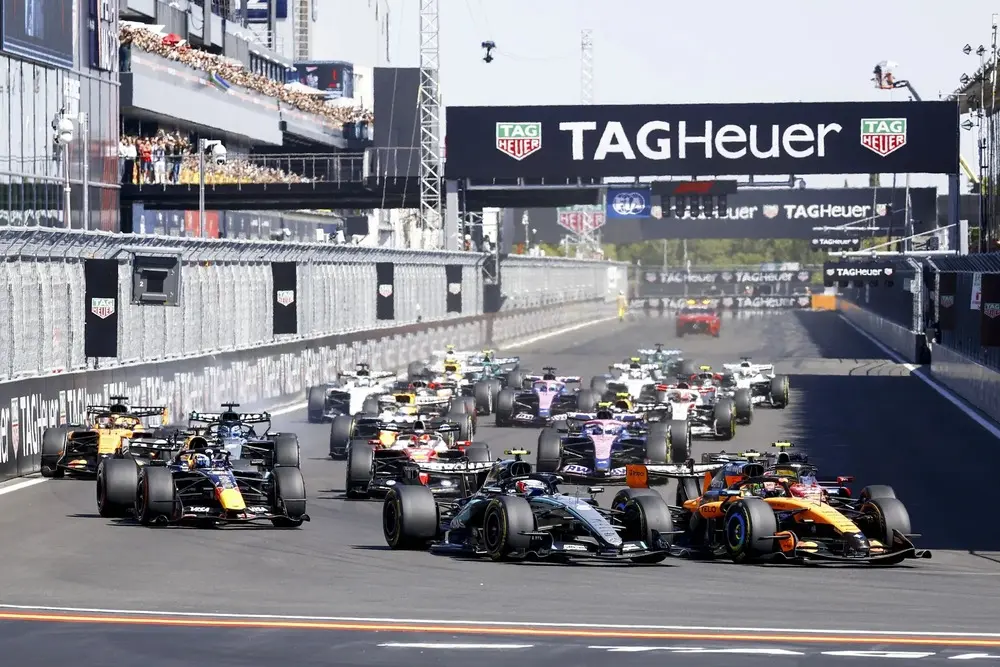
In response, the FIA has introduced a new safety‑oriented system for race starts, not just adjusting the timing of the lights sequence but also embedding clearer on‑car visual cues to warn following drivers when a car ahead is operating under reduced‑energy or emergency‑mode conditions.
One of the key innovations is the introduction of an associated visual warning system which activates rear and lateral flashing lights on cars that are operating under certain energy‑management or safety‑mode states.
These lights are designed to improve reaction times for drivers behind, giving them earlier notice that a car ahead may be slower or less responsive than normal, especially in the first few seconds of the start when the field is bunched at maximum speed.
The governing body has also reset the energy counter at the start of the formation lap, correcting a previously identified inconsistency in how the power‑unit software accounted for energy usage between the grid and the start line.
The change ensures that all cars enter the standing start phase with a more predictable and consistent energy baseline, removing unintended variability that could otherwise exaggerate differences in acceleration or straight‑line speed between cars.

Teams have already trialled modified start‑procedure timings and additional pre‑start phases in earlier testing, including a five‑second pre‑start phase where grid panels flash blue to allow drivers to build revs safely before the familiar five‑red‑lights sequence begins.
Wet‑Weather Rule Changes: Tyres, ERS and Visibility
Perhaps the most visible part of the April 2026 package is the set of tweaks aimed specifically at improving safety and performance in wet and mixed‑condition races.
Following feedback from drivers and engineers during pre‑season testing and the opening rounds of the championship, the FIA agreed to raise intermediate‑tyre blankets temperature and also dial back maximum ERS deployment in wet conditions.
Drivers have often struggled to bring Intermediates into their operating temperature quickly in light rain or mixed conditions, leading to a “tear‑off” phase where they lack grip and confidence.
By increasing tyre blankets temperature, Pirelli and the FIA hope to give drivers better initial grip when they switch to intermediates, reducing the risk of off‑track moments.
At the same time, the maximum ERS deployment in wet weather has been reduced, effectively limiting torque output on the rear axle to improve car control and reduce wheelspin in low‑grip conditions.
This is particularly important for the high‑downforce, high‑power 2026 cars, which can over‑rotate or spin the rears under maximum power if the ERS is used aggressively while the track is still damp.
READ MORE:
Mercedes and Red Bull F1 engine trick banned by FIA after safety concerns