

The opening morning of the final week of F1 Bahrain pre-season testing saw Ferrari debut new exhaust wing and an advanced power unit in a bid to maximize performance ahead of the 2026 Formula 1 season.
The new developments on the SF-26 were unveiled on the opening day of the second Bahrain test session from February 18-20, capturing the attention of the entire paddock as teams fine-tune their machines ahead of the Australian Grand Prix opener.
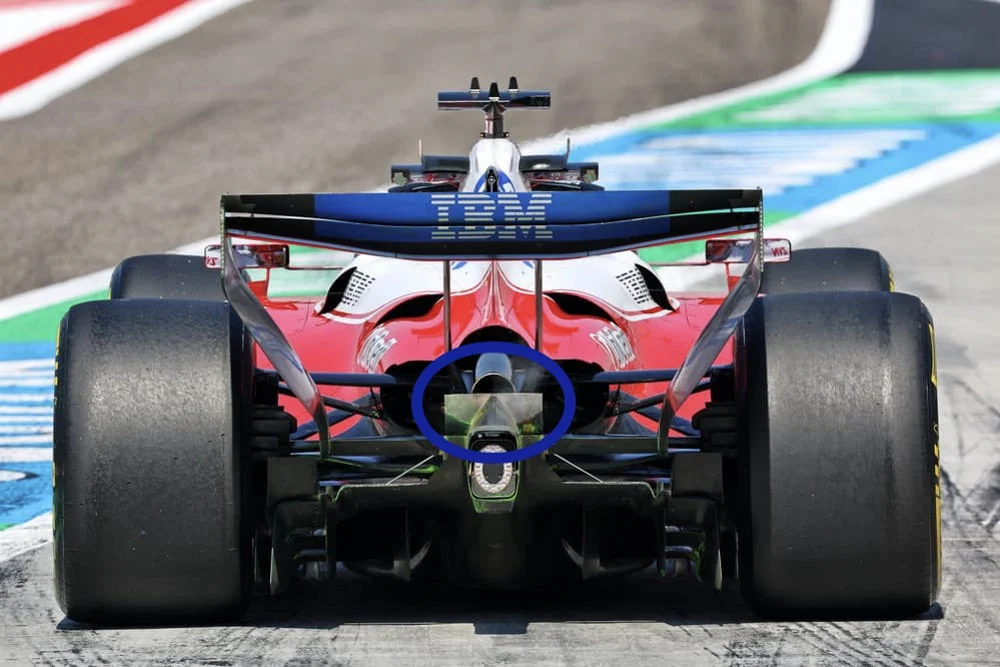
The new exhaust wing, a compact aerodynamic device positioned directly behind the Ferrari SF-26’s exhaust pipe, immediately stood out when Charles Leclerc rolled out for the morning session.
Referred to internally as FTM, the flap mechanism cleverly exploits the exhaust gas flow to enhance downforce and energy recovery even activating in low gears where traditional setups fall short.
This placement adheres strictly to FIA rules which permit such a device provided it does not exceed 60mm from the axle or protrude beyond the exhaust end, but Ferrari’s implementation pushes the boundaries of what’s permissible, sparking intense scrutiny from rival engineers.
Leclerc, who set Ferrari’s best lap of the Bahrain tests so far at 1m33.739s on unmarked C3 tyres during the first hour, demonstrated the wing’s potential by topping the morning timesheets before handing over to Lewis Hamilton for the afternoon stint.
Complementing the aero tweak is a fresh Ferrari 067/6 power unit (A-spec), a turbocharged 1.6-liter V6 hybrid that represents a pinnacle of reliability after clocking over 4,300 kilometers across the Fiorano shakedown, Barcelona private test and the first Bahrain session without major issues.
Hamilton’s long-run simulations, though interrupted by an engine shut down on the final day of Bahrain test 1, provided invaluable data on real-world fuel use which turned out to be marginally higher than simulated.
Following its heavy workload, the previous Ferrari 067/6 power unit will now undergo detailed wear inspections under the supervision of engine technical director Enrico Gualtieri and his department.
The brand-new A-specification for the final test days features a deliberately smaller Honeywell turbine compared to rivals like Mercedes—a strategic choice aimed at minimizing turbo lag and optimizing energy deployment.
Ferrari Project 678: Inside the bold 2026 F1 car development plan
How Mercedes F1 engine compression loophole works
By prioritizing quicker spool-up, Ferrari reduces reliance on the MGU-K during acceleration, conserving electrical power for high-speed straights—a philosophy that could yield significant advantages in starts and overtakes under the 2026 power unit rules where internal combustion output drops to 400kW while electrical power surges to 350kW in a 50/50 split.
A new gearbox will also be fitted alongside Ferrari’s new power unit. The new energy recovery strategies have forced teams to use shorter gear ratios than in previous seasons, increasing engine revs to help mitigate turbo lag which places greater stress on individual gears and the gearbox as a whole.
Therefore, the transmission system requires particularly close monitoring and evaluation to avoid potential reliability issues.
Ferrari’s superior acceleration capabilities
Simulations in Bahrain showed that generating optimal boost requires pushing the internal combustion engine to higher revs to properly spool the turbo. Power units equipped with larger turbines need more time to complete that process.
Observations in Sakhir suggested it takes roughly 10 seconds to activate the starting system. This potentially disadvantages drivers arriving late to their grid slot, as those at the front have ample time to arm the procedure.
Ferrari’s “small turbo” philosophy is partly why the team is resistant to regulatory adjustments after McLaren team principal Andrea Stella expressed safety concerns, warning of the risk of cars stalling on the grid if the procedure is not managed carefully.
The F1 Commission is scheduled to meet this week to discuss the matter alongside other hot topics, including the ongoing debate surrounding the Mercedes engine’s compression ratio.
As testing progresses into its final week, attention will be on how the new Ferrari SF-26 package effectively balances reliability and performance in Formula 1’s bold new era.
READ MORE:
2026 Bahrain F1 pre-season testing week 2 schedule: Driver line-ups, where to watch
Key 2026 F1 regulations changes explained: Comprehensive guide to Formula 1’s new era