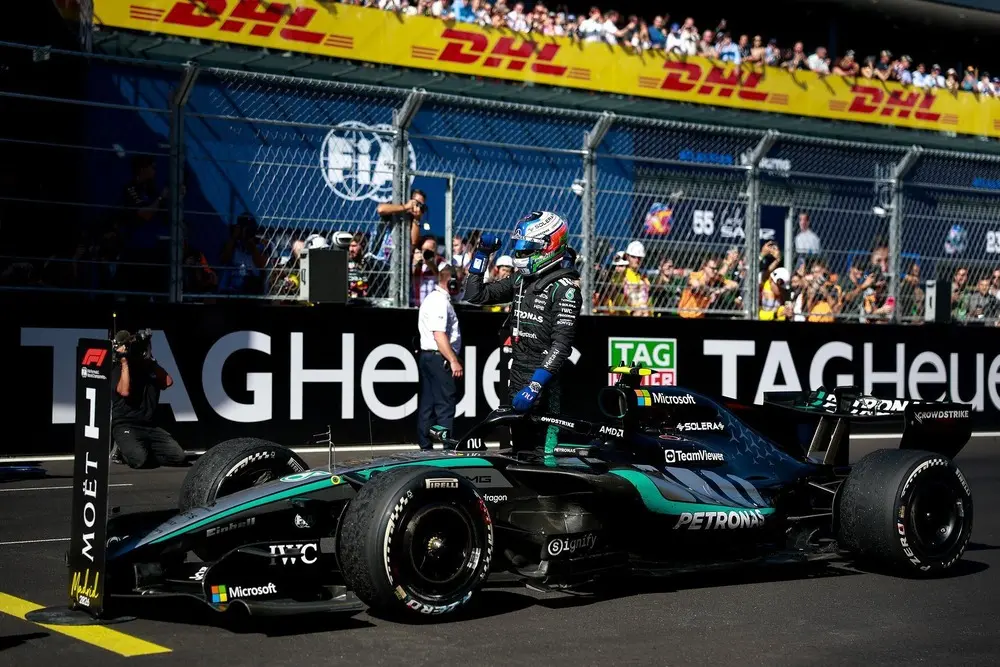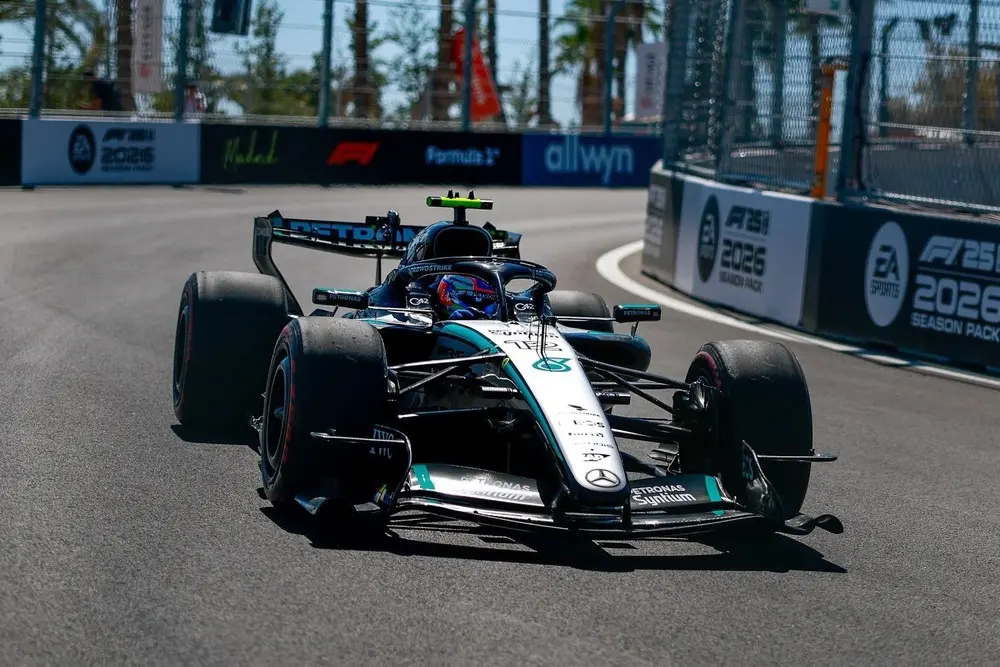
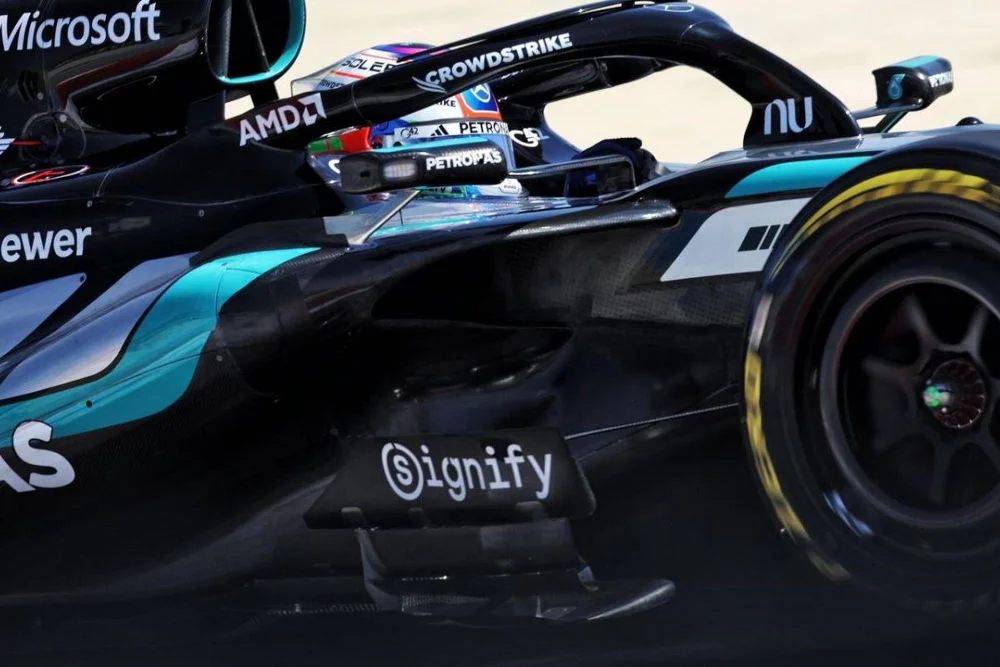
Several new Mercedes W17 upgrades were introduced on the final week of 2026 Formula 1 pre-season testing in Bahrain including revised sidepods, brake ducts, front wing endplates, floor and wing mirror mounts.
The bold move comes at a critical juncture, just weeks before the season opener in Australia, as the Brackley-based squad aims to reclaim its dominance with innovative aerodynamic and mechanical enhancements tailored for the 2026 power unit and chassis rules.
The W17, unveiled earlier in January, was already a departure from tradition featuring a smaller, narrower, and lighter chassis compliant with the 2026 F1 regulations that mandate active aerodynamics and a near 50/50 split between electric and combustion power.
However, the final Bahrain F1 test marked the first on-track deployment of what Mercedes trackside engineering director Andrew Shovlin described as a “sizeable upgrade package,” meticulously developed to optimize performance across the demanding Sakhir circuit.
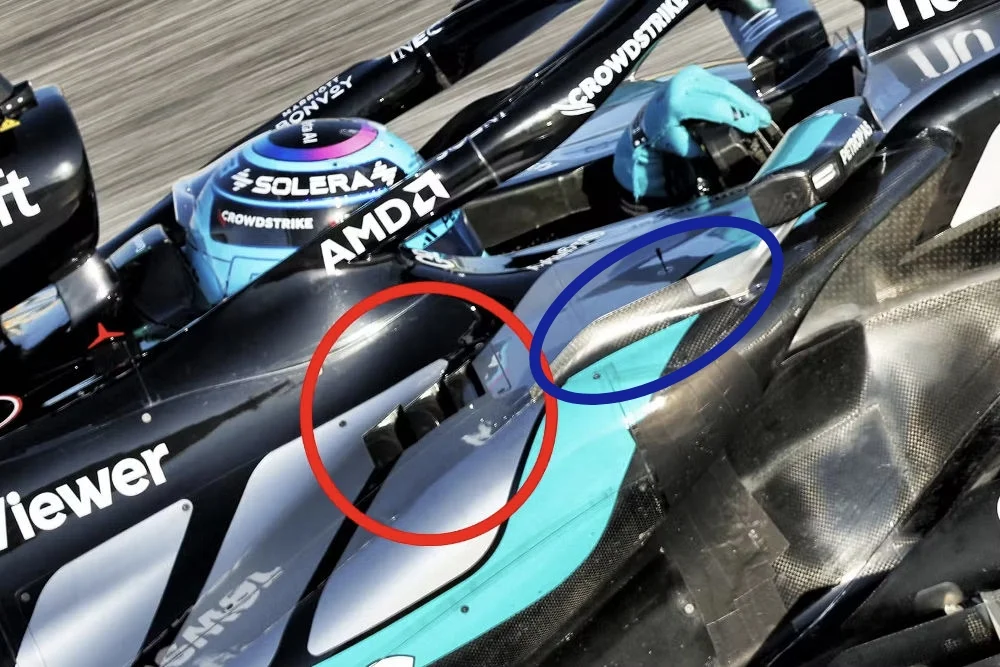
At the heart of the package is the revised sidepod design which adopts a more compact rear-end configuration to streamline airflow and reduce wake turbulence, a philosophy inspired by recent Red Bull concepts but adapted to Mercedes’ active aero strategy.
Engineers introduced updated cooling gills (red) atop the sidepod ensuring optimal temperatures for the engine.
Beside it is a new vane (blue) to better channel high-pressure air towards the floor edge, enhancing the effectiveness of the underbody venturi tunnels that are pivotal under the 2026 ground-effect rules.
Complementing this, the wing mirror mounts have been straightened for minimal interference allowing cleaner passage of dirty air from the front wheels—a subtle yet crucial tweak that could yield tenths in straight-line speed during qualifying simulations.
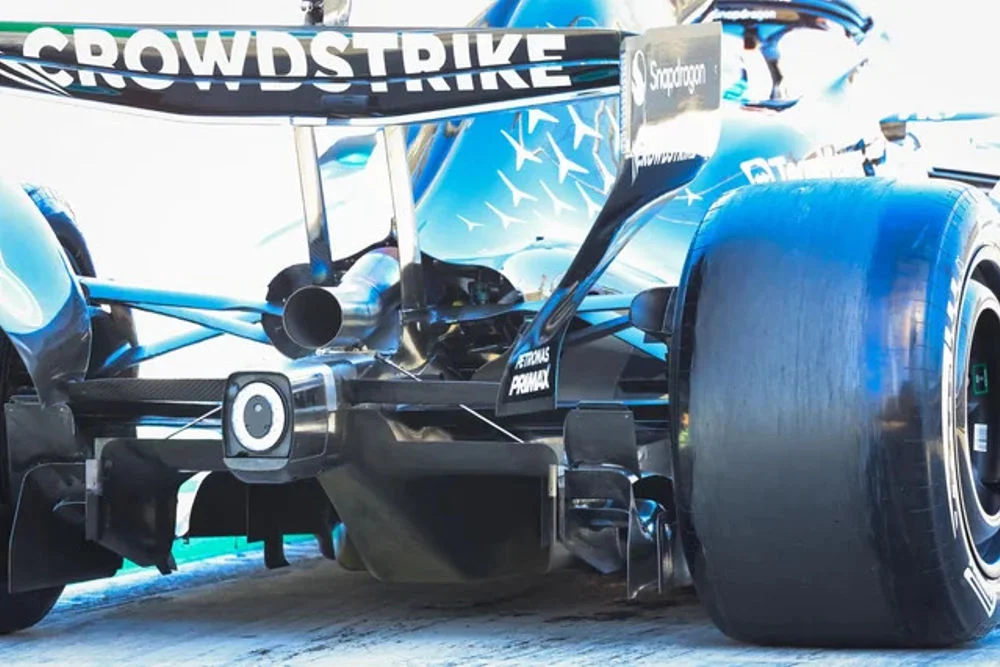
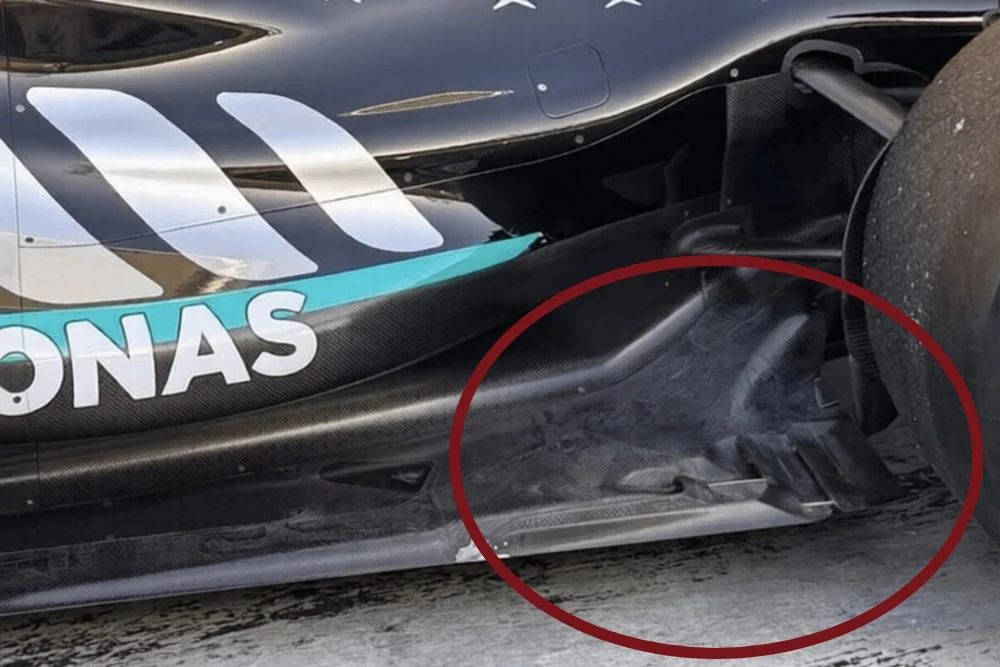
Floor changes form another cornerstone with a revised rear floor corner aimed at improving diffuser efficiency and sealing the vital gap between the car and the track surface.
This modification is particularly telling in Bahrain’s abrasive conditions where tyre degradation has been a focal point; Mercedes’ ability to control wear on the C3 medium compound during long runs suggests the floor tweaks are delivering the desired pressure equalization beneath the car.
Coupled with these are the new front wing endplates, incorporating horizontal vanes that follow a paddock-wide trend pioneered by McLaren, designed to energize the wake and feed cleaner air to downstream elements like the sidepods and floor.
Such refinements are essential in the 2026 era where movable front and rear wings via active aero systems demand precise upstream flow management to maximize boost and overtake modes without compromising cornering grip.
Upfront, revised brake ducts represent a sophisticated response to cooling demands under the new power unit regs which mandate sustainable fuels and heightened electrical deployment.
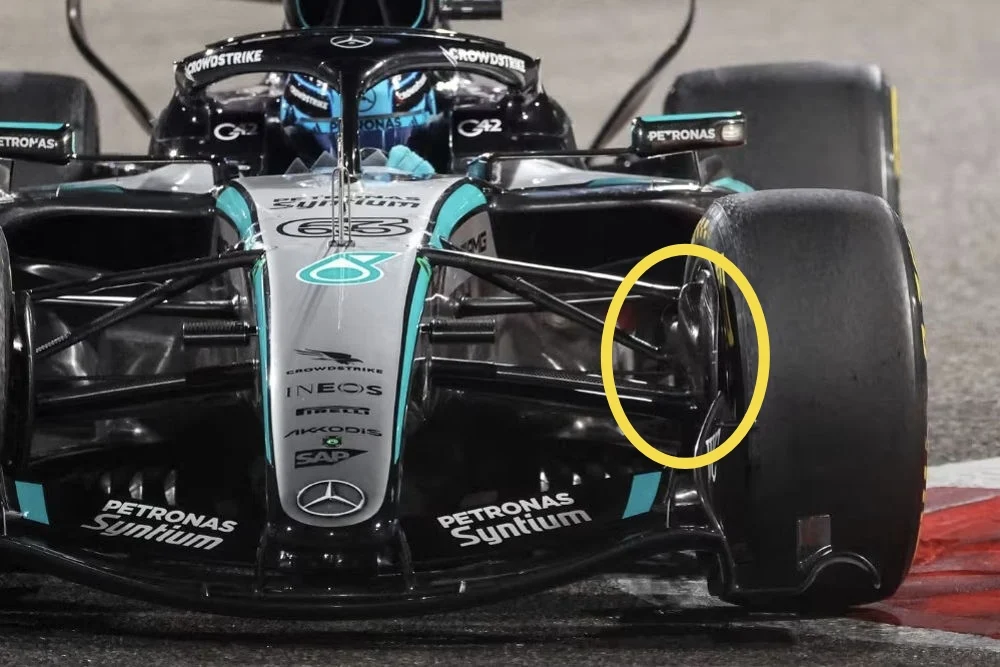
These ducts not only service the carbon brakes more efficiently but also scoop targeted air for intercoolers, mitigating the thermal challenges posed by the 50/50 ICE-electric split that produces power closer to previous V6 hybrids but with redistributed delivery curves.
Andrew Shovlin hailed the new Mercedes W17 upgrades after George Russell topped the timesheets on Day 1, while Kimi Antonelli set blistering pace on Day 2 as the duo clocked substantial mileage without issues.
“We have made a solid start to the final few days of testing completing 69 laps with Kimi and 78 with George,” Shovlin said. “We’ve updated a few parts on the W17 and they seem to be doing what we hoped.
“We’ve also been working through a programme of set-up items trying to understand more about the car and tyres.
“The track changes quite considerably over the course of a day here as it heats up and cools down so it’s often difficult to analyse results, but we seem to have been able to keep the car in a good window and it’s been encouraging to see that degradation has been under control.
“We’ve still got a lot of work to do as we go into the final two days so fingers crossed the W17 will continue to run reliably and allow us to get through our full programme.”
READ MORE:
Ferrari debut new exhaust wing and power unit at final F1 Bahrain testing
Mercedes’ Antonelli paces day two of Bahrain F1 testing, Aston Martin struggles persist