
The FIA revealed the No. 31 Haas failed the rear wing flex test getting Esteban Ocon disqualified from qualifying for Formula 1‘s Azerbaijan Grand Prix.
The disqualification came as a result of the rear wing main plane of Ocon’s car showing excessive flexibility beyond the strict limits imposed by the governing body under the 2025 technical regulations.
This incident overshadowed what was already a challenging qualifying session for the French driver at the Baku City Circuit, leaving him to start the race from the back of the grid.
The new regulation, introduced at the Chinese Grand Prix weekend and further refined at the Spanish Grand Prix, mandated a tougher rear wing flex test to ensure compliance with aerodynamic standards designed to promote fairness and safety.
Specifically, the deflection limit for the rear wing’s main plane under a 750 Newton-metre load was reduced significantly from 2 millimeters to just 0.5 millimeters.
The stricter rule was introduced following concerns that teams were exploiting aerodynamic flexing for competitive advantages, commonly known as “flexi-wings,” which can improve performance by reducing drag and increasing downforce under racing conditions.
The test involves applying a vertical load to the wing, and measuring the extent to which the wing flexes or bends, especially at the tips.
During the post-qualifying technical inspection, Ocon’s Haas car exhibited a rear wing deflection that exceeded the 0.5-millimeter threshold, with measurements recorded at 0.6mm on the left side and 0.85mm on the right side.
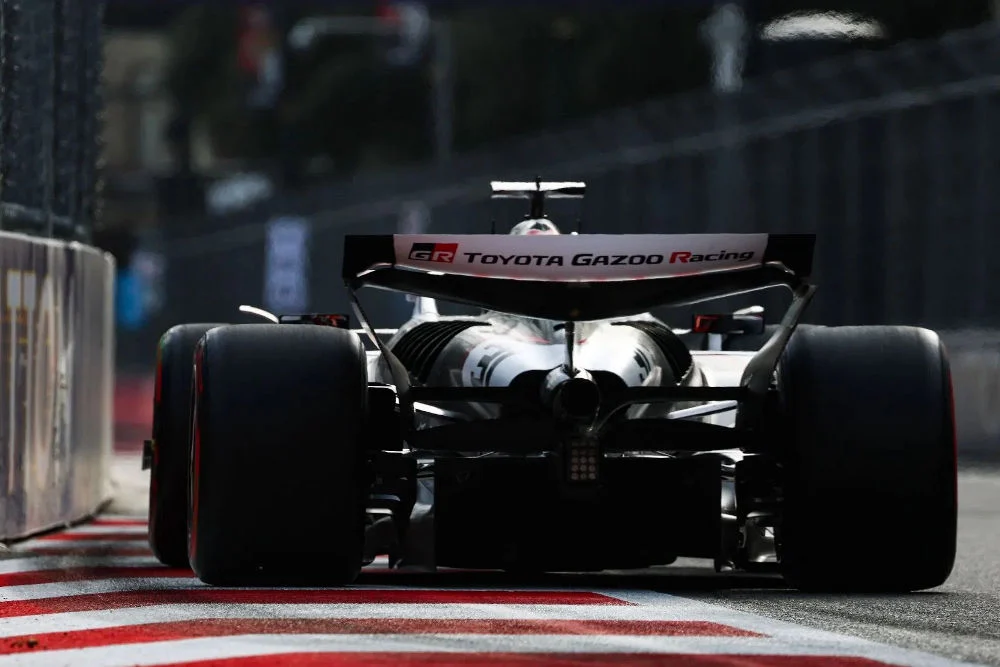
These readings were outside the allowed tolerance, prompting Formula 1 technical delegate Jo Bauer, to refer the matter to the stewards for further investigation.
In a hearing that followed, Haas accepted that the test was executed correctly using valid measuring instruments.
The team noted that the failure was the result of a production problem specific to that rear wing assembly, highlighting the precision and complexity involved in manufacturing compliant aerodynamic parts in Formula 1.
As a consequence, Ocon’s 18th-place qualifying result was nullified, and he was demoted to start last at the Azerbaijan Grand Prix.
Full 2025 F1 Azerbaijan Grand Prix starting grid
Azerbaijan Grand Prix – Full Qualifying Results
This was a significant blow not only for Ocon but also for Haas, as it compromised their starting position and potential points haul in what is always a highly unpredictable street circuit race in Baku.
Prior to the test that got Esteban Ocon disqualified, he had reported a consistent braking issue which compounded his troubles in qualifying.
“We had a massive braking problem in qualifying,” he explained. “I think in my lap I must have locked up three times and couldn’t get the car stopped, ran wide in most corners.
“Obviously, the wind didn’t make things easy, but that’s not the reason why we are out. We need to investigate that. It was the same thing in FP3.
“I was braking 30 or 40 bars less than Ollie and still couldn’t get the car stopped and I was going straight into the run-off areas. There’s much more pace in the car and it’s a day wasted, so I hope we can get some opportunities tomorrow.
“We’ve seen sometimes a bit of difficulties in braking, but today was out of this world. It was insane.”
The Azerbaijan GP qualifying itself was one of the most chaotic in recent memory, marked by six red flags—the most ever recorded in a single Formula 1 qualifying session—due to multiple incidents and tricky conditions on the narrow and fast Baku streets.
The disqualification of Ocon was among the standout stories of the session, which saw Max Verstappen claim pole in wet and challenging conditions, with surprise front-row starter Carlos Sainz in his Williams and Liam Lawson securing third in a Racing Bulls entry.
READ MORE:
2026 F1 driver line-up: Who has been confirmed so far?
F1 driver net worth 2025: The 12 richest drivers on the grid