
Formula 1 pundit Martin Brundle has called on the FIA to urgently address “fundamentally flawed” F1 power delivery system following Oliver Bearman’s Suzuka crash.
Brundle’s intervention has reignited a broader debate over how far the hybrid power units can be allowed to self‑regulate without compromising predictability, driver control and ultimately safety on circuit.
His comments come at a delicate moment for Formula 1 as the sport tries to balance the technical ambitions of its 2026 rulebook with the realities of closing‑speed differentials and the physical consequences of rapid deceleration on wheel‑to‑wheel racing.
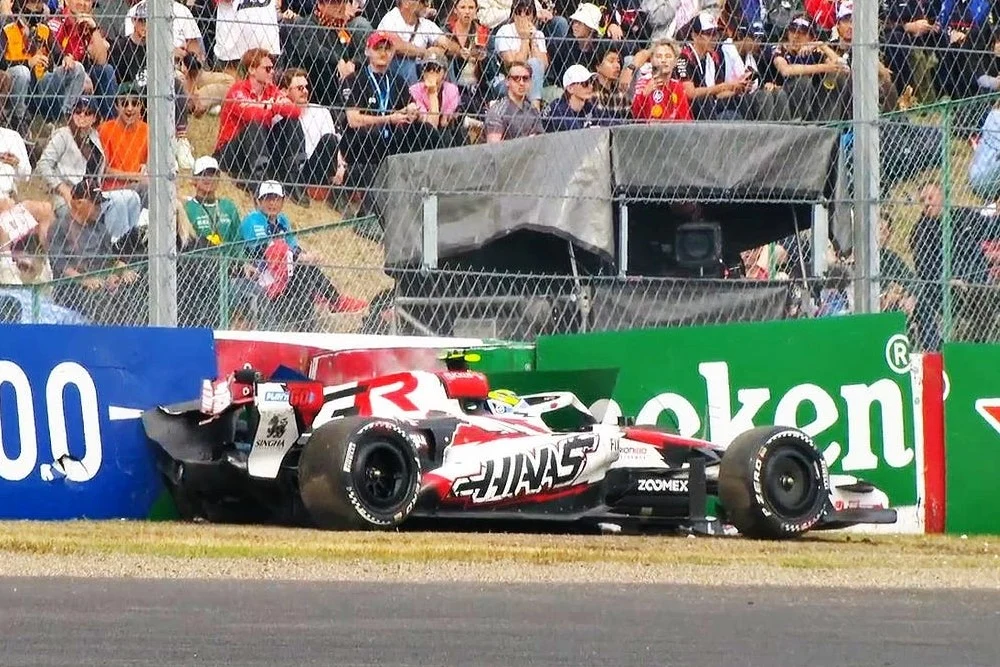
The Japanese Grand Prix gave that criticism a powerful real-world context after Haas’ Oliver Bearman, running at full attack, encountered Alpine’s Franco Colapinto who was in the middle of energy‑harvesting.
As Bearman approached along the long, flat‑out Suzuka straight, Colapinto’s car momentarily scrubbed speed to pull electrical energy back into the battery, creating a sharp speed differential that left the chasing driver with very little time to react.
Bearman attempted an evasive maneuver but lost traction which sent him drifting onto the grass across the runoff and slammed into the barriers at 308km/h, recording an impact of around 50G before crawling out of the shattered chassis.
Although he was later cleared of fractures—only sustaining a contusion to his right knee—the nature of the crash has become a focal point for larger questions about the interaction between the 2026 power units, driver inputs and safety.
Speaking on the Sky Sports F1 Show, Brundle defended Colapinto’s actions claiming that significant closing speed between the drivers led to a dangerous situation.
“Well, it was high closing speeds. I think Franco Colapinto, I don’t think there was any malice in there. He could have given him a bit more space,” Brundle said.
“I suspect he was looking down at his steering wheel, trying to work out what was going on with a gutless racing car underneath him that wasn’t accelerating.
“Ollie’s obviously on full beans and coming at him. And they just met in the middle on a very long flat-out curve.”
Martin Brundle went on to highlight the critical F1 power delivery flaw that comes with integration of “self‑learning” functions in the new hybrid engine.
Instead of a simple, proportional relationship between pedal position and forward thrust, drivers now contend with a complex cocktail of energy deployment maps, automatic recuperation triggers and transient power spikes that can surprise even the most experienced pilots mid‑corner or on long straights.
Brundle contends this shift removes the fundamental predictability that has long been a cornerstone of Formula 1’s safety envelope, turning potentially manageable closing‑speed scenarios into near‑unavoidable snares.
“It’s always been an issue. It’s been an issue at Le Mans. It’s been an issue in Formula 1, cars slowing down in front of you with engine problems or whatever,” he explained.
“But back in the day, we probably had some clues that was going to happen. You could smell the oil burning, see some smoke, or hear an engine misfire. If a driver in front of you missed a gear when we had manual gearboxes, that happened a lot. So, you’re always ready for it.
“Closing speeds in qualifying as when we used to have the turbos and qualifying tyres would be double what they are now, for example. You had to manage it. So, let’s not pretend that’s a 2026-only issue.
“Now, there’s a regulation in Formula 1. It’s been around forever. It’s very simple and far-reaching. The driver must drive the car alone and unaided. The driver shouldn’t have any surprises by a self-learning car. They’ve got to get rid of that.
“I’m sure it’s not the work of the moment, but the power delivery must be proportional to what the driver is doing with the throttle. That’s a fundamental. It has to be linear, as I said. It’s a big issue for the FIA because its driver safety is sacrosanct.”
The FIA is under pressure from the drivers to implement F1 rule changes before the upcoming Miami Grand Prix.
READ MORE:
Haas issues update after Oliver Bearman’s Suzuka crash as calls for F1 rule changes intensify
FIA makes F1 qualifying rule change after energy-harvesting concerns