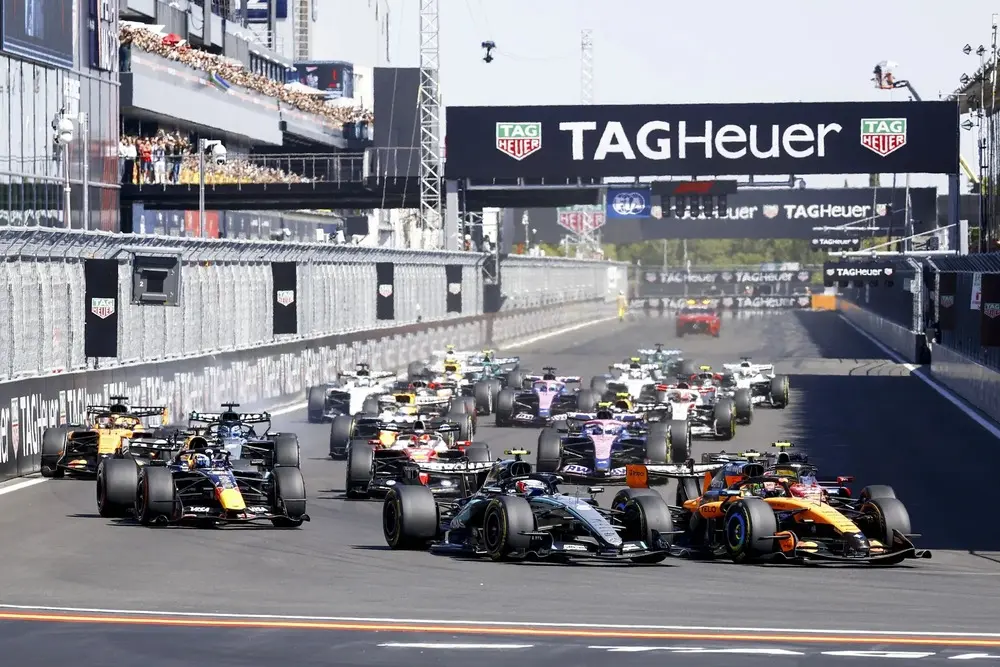

FIA president Mohammed Ben Sulayem has revealed the return of F1 V8 engines might happen as early as 2029 in a bid to cut down spiraling costs associated with developing current power units.
While Formula 1 anticipates sweeping 2026 regulation changes with revised 1.6-litre turbo-hybrid V6 engines, Sulayem has called for cheaper alternatives and he believes that may happen in the near future.
Ben Sulayem’s vision for a return to V8 power units is underpinned by substantial practical, commercial, and technical arguments.
His rallying call is in part an answer to skyrocketing development costs that have begun to threaten the sustainability of smaller teams and the accessibility of the championship for new entrants.
According to the FIA president, the research and development cost for the current hybrid engines is reaching $200 million, with each engine itself priced at approximately $1.8–2.1 million.
Such figures dwarf the expenditures seen in previous generations, notably the V8 era, and raise significant barriers for all but the wealthiest competitors.
“To us, the V8 is happening,” he told media at Silverstone during the British Grand Prix weekend. “With the teams now, I’m very optimistic, and happy about it.
“FOM (Formula One Management) are supportive, the teams are realising it is the right way. The current engine is so complicated, you have no idea, and it is costly.
“R&D is reaching 200 million (dollars), and the engine is costing approximately 1.8 to 2.1, so if we go with a straight V8, let’s see.”
An equally notable aspect of Ben Sulayem’s proposal is its focus on commercial viability and manufacturer alignment. He pointed out that many global automotive manufacturers still produce V8 engines for their road cars, making the switch a “commercially correct” move.
He added: “Many of the manufacturers produce V8s in their cars, so commercially it’s correct. How much is it? You drop it. The target is more than 50 percent in everything.
“We need to do it soon… you need three years, so hopefully by 2029 we have something there, but the fuel is also very expensive, and we have to be very careful with that.
“People think that Formula 1 is unlimited money, but not all the teams. So this is something now we are having the buy-in.”
READ MORE: F1 2026 calendar update: New pre-season testing dates confirmed
While a return to the loud, visceral, and crowd-pleasing V8s would undoubtedly rekindle emotional connections with long-time fans and draw new spectators enticed by the promise of more thrilling on-track action, numerous hurdles remain on the path to regulatory consensus.
The next-generation power unit regulations were only recently set for a major overhaul in 2026, with a planned increase in electrification and an attempt to achieve a more balanced split between combustion and electric power.
Any drastic change, especially one shortly after such a major regulatory shift, introduces potential friction among teams and manufacturers that have already invested heavily in the new hybrid formulas.
Indeed, earlier in 2025 the idea of an even more ambitious return to V10 engines was floated by Ben Sulayem. That proposition triggered an emergency meeting during the Bahrain GP where the sport’s OEMs including newcomers like Audi, voiced significant resistance rooted in both commercial commitments and environmental targets.
As a result, the FIA pivoted from V10s to the more feasible and familiar V8 configuration.