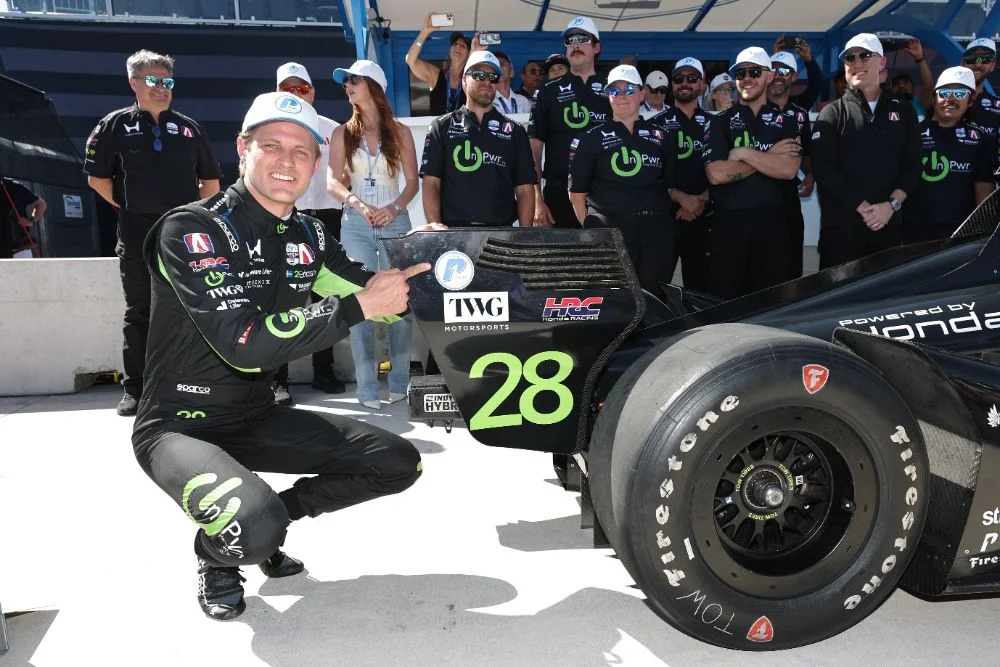
Marcus Ericsson secured his first career IndyCar pole position at the inaugural Java House Grand Prix of Arlington, a monumental achievement after 117 starts in the series.
The 35-year-old Swede, driving the No. 28 InPwr Andretti Honda, clocked a stunning lap time of 1:34.3562 around the challenging 2.73-mile, 14-turn temporary street circuit snaking through the shadows of AT&T Stadium and Globe Life Field in Arlington, Texas, averaging an impressive 104.158 mph.
This pole came in the debut of a brand-new qualifying format for the Firestone Fast Six, where the top six qualifiers from the previous round were inverted, sending the slowest of them out first for a high-stakes, single-lap shootout, and Ericsson, as the sixth to go, delivered under immense pressure.
Qualifying for the 2026 IndyCar Arlington Grand Prix kicked off with two group sessions in Round 1, splitting the 25 entries into Group 1 and Group 2, each running 10-minute sessions where the top six from each advanced to Round 2, while the rest were locked into positions 13th through 25th based on their times.
In Group 1, all eyes were on reigning four-time champion Alex Palou, who had slipped in the standings after a crash in Phoenix the previous weekend but wasted no time asserting dominance, posting the fastest lap of the group in the sub 1:34s to comfortably advance alongside championship leader Josef Newgarden.
The group saw smooth sailing for most with no major incidents as rookie Mick Schumacher just scraped through in a photo-finish battle for the final transfer spot in his No. 47 Rahal Letterman Lanigan Honda.
Group 2 brought more drama as Scott McLaughlin in the No. 3 Team Penske Chevrolet topped the timesheets early, mirroring his Practice 1 dominance but his session ended in disaster when he clipped the inside wall at Turn 8 late in the run, spinning into the barriers and posting no competitive time, relegating him to last on the grid.
Full 2026 IndyCar Arlington Grand Prix Qualifying Results
Three IndyCar rule changes for 2026 you need to know
As the checkered flag waved on Round 1, the 12 fastest drivers—six from each group—advanced to Round 2, a 10-minute frenzy where they fought for the six spots in the innovative Firestone Fast Six final.
Kyle Kirkwood set the early pace in the No. 27 Andretti Honda, ripping off a blistering 1:33.8868 that emerged as the quickest lap at the time, but his push lap setup faltered just enough to keep him out of the final six by a heartbreaking 0.4819s.
Christian Rasmussen followed closely in the No. 21 Ed Carpenter Racing Chevrolet at 1:34.1440, showcasing the team’s street course prowess, while David Malukas in the No. 12 Team Penske Chevrolet impressed with 1:34.2456, proving the Penske machines were dialed in despite McLaughlin’s woes.
Alexander Rossi’s No. 20 ECR Chevrolet slotted into 10th, followed by Josef Newgarden’s No. 2 Team Penske Chevrolet and Santino Ferrucci’s No. 14 A.J. Foyt Chevrolet.
The inversion for the Firestone Fast Six sent Marcus Armstrong out first in the No. 66 Meyer Shank Racing Honda, the Kiwi posting 1:35.6012 but struggling with tire temperature on his single flying lap, as the new format’s one-and-done nature amplified the risk of cold rubber ruining a run.
Felix Rosenqvist followed in the No. 60 Honda, improving to 1:35.1607 but still off the pace, while Will Power paced the No. 26 TWG Andretti Honda to provisional third at that point.
Arrow McLaren’s Pato O’Ward then lit up the timing screens with 1:34.8453, briefly threatening the top spot, followed by Alex Palou who carried the weight of expectations as the series’ defending king, but his 1:34.8180 left him 0.4618s off the benchmark.
Finally, Marcus Ericsson rolled out last and proceeded to nail every apex from Turn 1’s sharp left-hander off the pit straight through the flowing stadium complex, braking late into Turn 8 and carrying speed onto the long backstraight to snag his first career IndyCar pole position.
READ MORE: Josef Newgarden takes IndyCar victory in Phoenix as Alex Palou crashes