
Genesis Magma Racing successfully completed the first endurance test of its new GMR-001 Hypercar last week in a three-day run at the Autódromo Internacional do Algarve in Portugal.
The testing phase proved pivotal for the team as it prepares for its highly anticipated debut in the 2026 FIA World Endurance Championship (WEC) season.
The prototype endured continuous running totaling 32 hours, a considerable feat that allowed the team to closely monitor the car’s performance, reliability, and durability under extreme racing conditions.
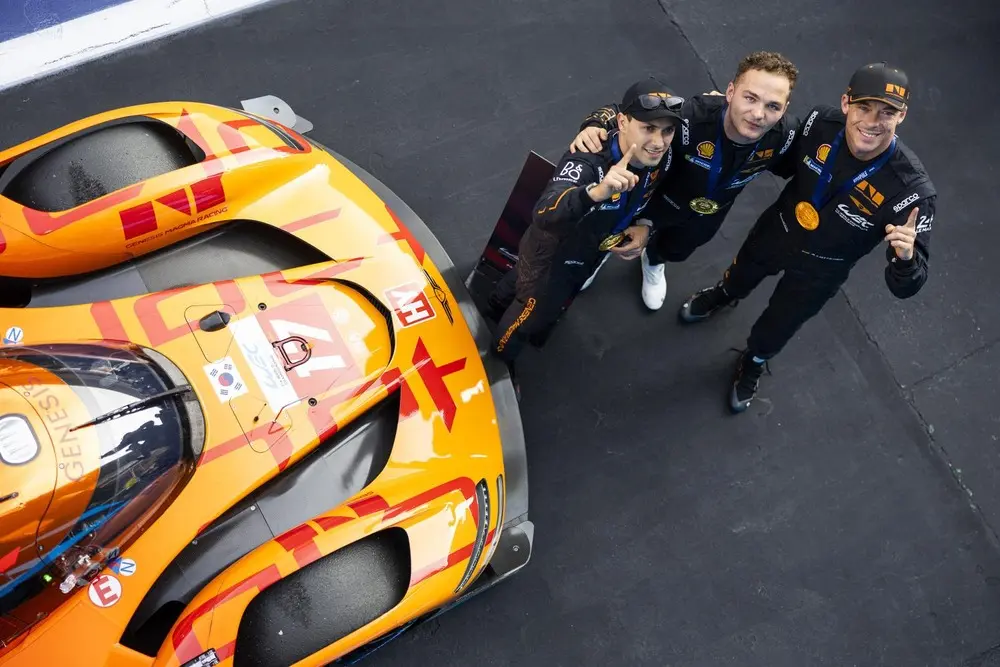
All Genesis Magma Racing drivers participated in the landmark test including experienced endurance racers André Lotterer and Pipo Derani, along with newly signed drivers Dani Juncadella and Mathys Jaubert.
Both Juncadella and Jaubert, who are currently strong contenders in the European Le Mans Series LMP2 standings, had their first experience behind the wheel of the Genesis GMR-001 Hypercar during this test.
Jaubert lauded the car’s power and drivability, remarking on the exceptional ease of finding rhythm despite the GMR-001’s tremendous power output.
“Driving the GMR-001 Hypercar for the first time was something very special,” said Jaubert. “It’s very powerful, much more powerful than anything else I’ve driven, but it is easy to drive.
“It’s easy to find the rhythm in it. It was like I was dreaming. Since I was very young, I’ve aimed to enter the highest class of the endurance racing, and I’m very happy to be there and to share the car with amazing drivers such as Dani, Pipo and Andre.”


Juncadella contributed his extensive endurance racing experience, offering insights that span across different manufacturers and competitive environments, thus lending a broader perspective to the development process.
“I think as new drivers to the project Mathys and I can support a lot with feedback,” Juncadella added. “Even though I have no experience in the Hypercar class, I do have a lot of experience in endurance racing with different manufacturers.
“I’ve been working in high- performance environments for many years in my career and can bring those different experiences to the development.”
Full 2026 FIA WEC calendar: Eight rounds confirmed
BMW M Hybrid V8 Hypercar gets aero updates for 2026 FIA WEC and IMSA
Chief engineer Justin Taylor emphasized the goal of an endurance test at this developmental stage is to accumulate mileage and identify any potential issues to be resolved moving forward.
“The main target of an endurance test is to put miles on the car and see what problems you can generate along the way,” said Taylor. “We’re still only six or seven test days into the development of the car, so at this stage you’re hoping to have problems show up so that you have a chance to solve them.
“I think we can be satisfied with the outcomes from the test. We did a lot of mileage, but we’re very early in the development of the car, so we were learning something new with every stint, which we can take away and on to our next tests.”
The positive outcomes from the Algarve test have provided confidence that the GMR-001 is on the right track, setting a strong foundation for upcoming testing and race preparations.
Taylor added: “Our next tests are going to be more adding performance. We’re going to have more opportunities to change calibrations, change software, change parts and then just keep on pushing.
“Then we get to put that through our next endurance test.”
Prior to the endurance tests, the GMR-001 underwent several shakedowns and shorter testing events, at Circuit Paul Ricard.
The initial runs focused on calibrating the car’s software and mechanical systems, alongside accumulating vital mileage with the input of lead drivers Lotterer and Derani, who collectively completed over 500 laps around the French circuit.
READ MORE: