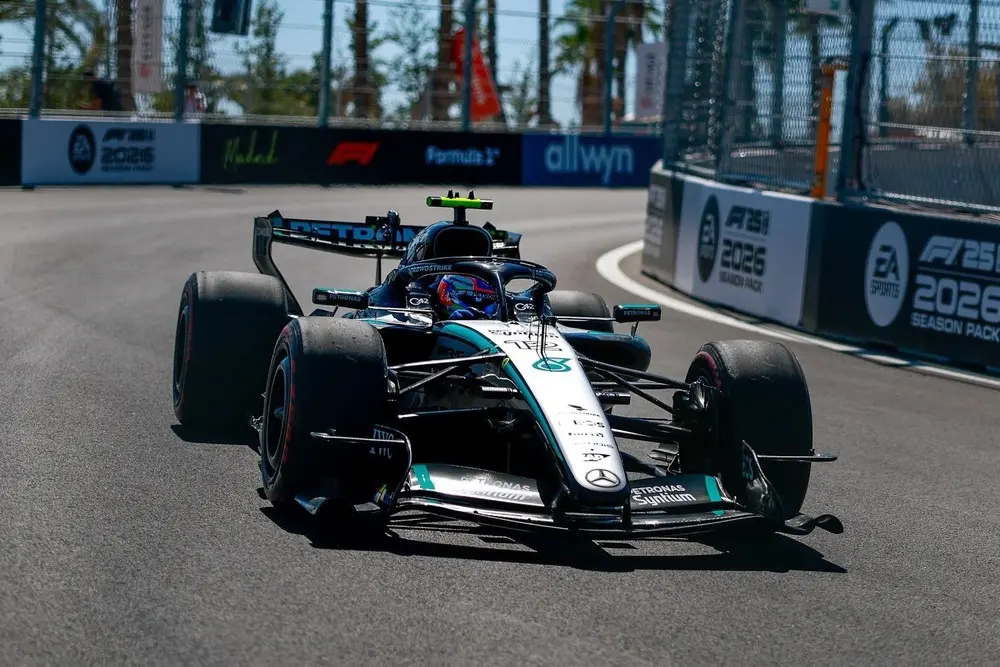


Ferrari has requested formal clarification from the FIA regarding the Mercedes F1 front wing legality as the team finds itself at the center of regulatory scrutiny once again ahead of Formula 1 Japanese Grand Prix.
The Scuderia petitioned the governing body on the possibility that the W17 is running a complex two-phase front-wing closure mechanism outside the intended scope of aerodynamics regulations, citing concerns over sensor readings and timing alignments.
Reports from Italian publication AutoRacer, highlight footage analysis from the Chinese Grand Prix showing the front wing flap closing in approximately 800 milliseconds—double the FIA’s strict 400-millisecond limit for transitions between Straight Line Mode and Corner Mode under the 2026 F1 active aerodynamics regulations.
It is believed the Mercedes W17 is achieving this through a sophisticated “two-phase front-wing closure mechanism” which allegedly allows the flap to fool FIA sensors while optimizing aerodynamic performance corner by corner.
According to detailed breakdowns from F1 analysts and video experts, the initial phase of closure happens rapidly within the regulatory 400ms window, satisfying the sensors that monitor the wing’s movement via onboard telemetry.
Once the system registers as compliant, a slower secondary phase completes the flap’s journey to its fully closed position, potentially shedding drag more gradually under high aero loads in braking zones like Shanghai’s Turn 14, thereby maintaining better balance, top speed into corners and overall lap time advantages.
The clever Mercedes front wing ingenuity, if proven, could explain their “big advantage” last weekend in China where George Russell and Kimi Antonelli dominated both the sprint and main race, solidifying the Silver Arrows’ lead in both the drivers’ and constructors’ championship rankings.
Mercedes’ resurgence in 2026 has been nothing short of spectacular, transforming from underdogs in the ground-effect era to outright dominators with wins in Australia and China, propelling them ahead of Ferrari in the standings.
The Mercedes W17 upgrades unveiled during final Bahrain test such as a reduced-thickness endplate and an enlarged diffuser “mouse hole” to manage tyre squirt and flow stability, have clearly hit the sweet spot under the new active aero rules introduced for 2026.
Ferrari protest adds fuel to a season already rife with technical skirmishes involving Mercedes, including earlier debates over their engine compression ratio and customer team data sharing.
The FIA is yet to deliberate whether the clever engineering falls within the rules or it exploits a loophole in how the FIA measures active‑aero transitions.
READ MORE:
Full 2026 F1 Japanese Grand Prix schedule: Start times, where to watch
Ferrari’s rotating rear wing explained: How it works and why it’s legal