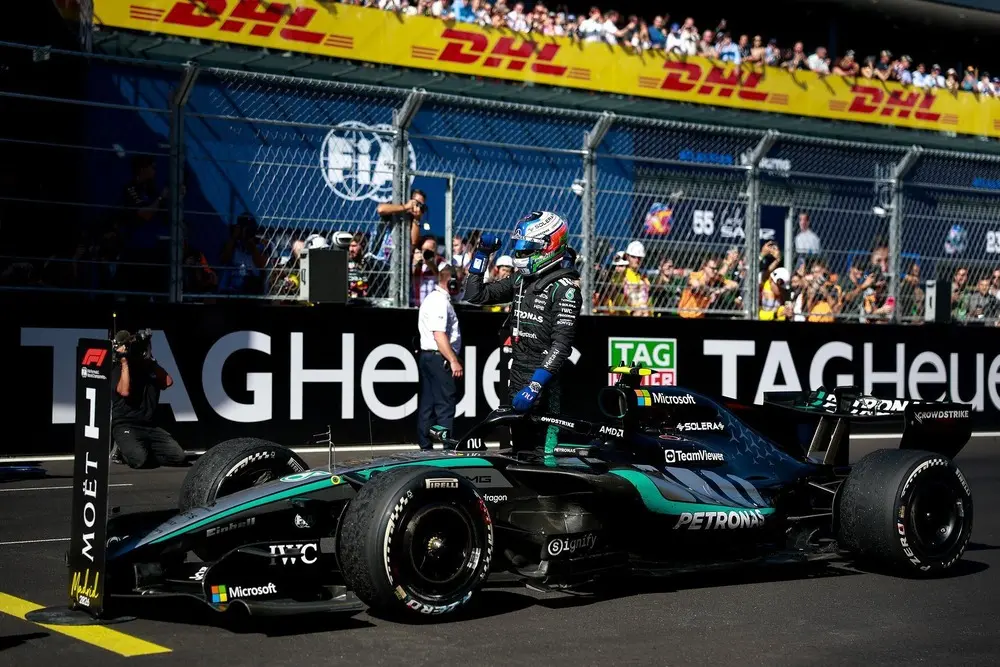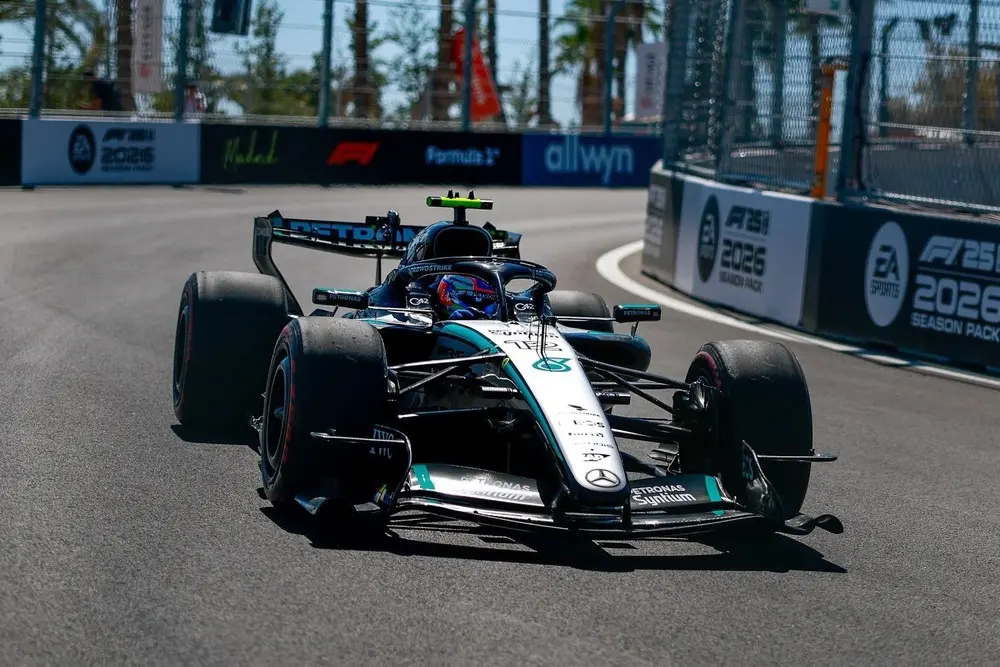

Mercedes unveiled a groundbreaking prototype front wing during Formula 1‘s Abu Dhabi post-season test, offering the first tangible glimpse into 2026 F1 active aerodynamics as teams race to adapt to sweeping new regulations.
This development, tested on a Mercedes mule car driven by promising youngster Andrea Kimi Antonelli at the Yas Marina Circuit, signals the dawn of a new era as the sport ditches DRS to embrace fully active aerodynamics on both front and rear wings.
The front wings will evolve from passive components to dynamic, driver-controlled devices capable of switching between high-downforce configurations for cornering grip and low-drag ‘Straight Line Mode’ setups for blistering straight-line speeds.
The design’s rudimentary yet bold execution, featuring prominent tubing linking actuators from the nose cone to the upper wing flaps, underscores Mercedes’ aggressive approach to pioneering these changes ahead of rivals.
As Formula 1 hurtles toward its most transformative rules since the hybrid era began in 2014, the new 2026 F1 regulations mandate significantly lighter, more agile cars with reduced dimensions, narrower tracks, and a shift away from the current ground-effect philosophy that has dominated since 2022.
Active aerodynamics represent the cornerstone of this overhaul, replacing the position-dependent DRS system—long a staple for overtaking—with a more versatile ‘Z-Mode’ for corners and ‘X-Mode’ for straights, allowing drivers to toggle wing positions independently of proximity to the car ahead.
The new Mercedes front wing design exemplifies this paradigm shift: in its high-downforce state, the wing elements maintain a tightly packed profile to generate substantial front-end grip, essential for the narrower, lighter 2026 chassis that will weigh just 768kg compared to today’s 798kg beasts.
When activated into Straight Line Mode, hydraulic or electromechanical actuators—visibly prototyped via those chunky external tubes—pivot the upper flaps rearward and flatten the profile, reducing drag by an estimated 20-30% while preserving overall car balance through synchronized rear wing deployment.

This dual-mode functionality addresses a critical challenge: without DRS’s rear-only focus, front wing adjustability becomes paramount to prevent understeer in low-drag scenarios, a pitfall that plagued early active aero concepts in wind tunnel simulations.
The Abu Dhabi test which was limited to nine hours of running across all 10 teams on Pirelli’s developmental 2026 tyres, served as a perfect proving ground for such innovations.
The FIA permitted teams to run 2026 F1 active aero parts and benchmark performance without compromising the session’s primary tyre-focused mandate.
Jak Crawford tops Abu Dhabi post-season test, Mercedes emerges as the fastest mule car
Full 2025 F1 Abu Dhabi post-season test results
Antonelli’s W16 mule car, shod in the sleeker, lower-profile 2026 rubber, clocked competitive laps while cycling the Mercedes front wing design through modes, gathering telemetry on load distribution, wake sensitivity, and actuation response times.
Observers noted the system’s ‘crude’ aesthetic, with large-bore tubing snaking from the nose’s internal reservoirs to wing-mounted pistons, betraying its early-stage status.
Yet this transparency belies sophisticated engineering beneath, likely incorporating pressure sensors, servo motors, and real-time ECU integration to ensure seamless transitions within milliseconds.
Ferrari is reported to have followed with a more polished iteration later during the day, hinting at an intensifying arms race where active front wing kinematics could dictate pole position supremacy.
Pirelli’s Head of Motorsport Mario Isola welcomed the FIA’s decision to allow the technology to be tested in Abu Dhabi. without have a of about
“Talking about the front Straight Line Mode, the FIA gave the opportunity to the teams to develop a system that was replicating this on the front wing. In that case, obviously, they don’t have to comply with the speed limit restriction,” Isola explained in reference to the 300km/h speed limit mandate on Mule cars to avoid overloading the tyres.
“It’s also useful for us because you can compare a car that is running without the system with a car that is running with the system. When we did the first test with Ferrari with the system, it was really useful to understand and to compare this test with all the other tests, in terms of load and what we achieved, to understand and to make the other tests more representative.”
READ MORE:
Helmut Marko’s Red Bull F1 exit confirmed after a 20-year tenure as advisor
Full 2026 F1 driver line-up: Who will be on the grid next season?