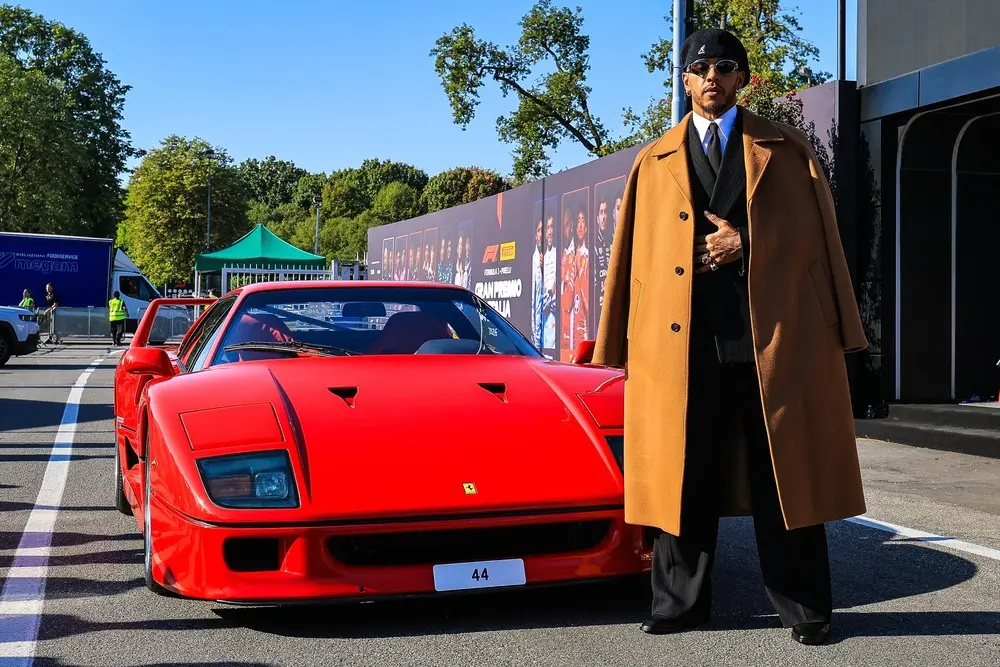
Lewis Hamilton made an iconic arrival into the Monza paddock driving his newly acquired and restored Ferrari F40 ahead of the Formula 1 Italian Grand Prix.
The seven-time world champion pulled up in the wedge-shaped supercar wearing a sharp black suit, tan overcoat and flat cap, with the F40’s front plate proudly displaying his signature “44” race number, a nod to the number on his father’s Vauxhall Cavalier that took him to karting events as a child.
With just 1,311 units built between 1987 and 1993, the F40 was conceived as a celebration of Ferrari’s 40th anniversary and as a no-compromise supercar that captured the spirit of the brand’s racing DNA.
It was the last road car personally signed off by Enzo Ferrari, featuring a twin-turbocharged V8, lightweight construction, raw interior and unmistakable design which gives it an almost sacred status among collectors and enthusiasts.
Behind Lewis Hamilton’s new Ferrari F40 is a tale as compelling as the spectacle of his arrival into the Monza paddock. The 41-year old driver revealed last year that he sold a huge chunk of his personal collection to focus more on art, but still held a special place for the F40.
Hamilton wanted an F40 with low mileage, original paint and a story worth telling, and he was willing to pass on cars that had been repainted, heavily modified, or lacked a compelling provenance.
Over the past couple of years, several F40s had come up at auction, some with very low miles but in his view they lacked the particular spark he was looking for.
His search ultimately settled on a car that was just driven for 69 kilometres by the previous owner, from the Ferrari factory to his home and remained under a cover undisturbed for more than three decades, accumulating a fine layer of dust.
The passenger door had reportedly never even been opened, which in Hamilton’s words, made it feel like a forgotten work of art waiting to be rediscovered.

Although the price tag remains under wraps, Hamilton chose to involve Ferrari itself in the restoration process, sending the F40 to the brand’s Classiche department, the division responsible for restoring and certifying Ferraris that are over 20 years old.
“It just had this cover on it and all this dust,” he explained. “Then the decision was kind of, ‘What do you do? Do you keep it as an art piece, keep it all dusty, or do you have them clean it up?’ So that took me a while to decide, and then I had them redo it because I wanted to drive it.”
Ferrari technicians ultimately confirmed the F40 had stood the test of time remarkably well, with almost all of its original components still functional and requiring only minimal intervention to be roadworthy again.
It was during this meticulous inspection, however, that a detail emerged which transformed the car from a dream acquisition into something that felt like fate.
When the engine was removed for inspection, the team discovered it was stamped on the engine number 44, the same number Hamilton has used throughout his Formula 1 career and indelibly associated with his identity on track.
“What was also crazy is when they were taking the car apart to check it, firstly, it stood the test of time — everything was still working,” he said. “Hardly anything had to be changed.
“And when they took the engine out, they found out the engine’s number 44. It’s got stamped on the engine number 44. I couldn’t believe it. I was like, ‘Did you know? You’ve got to be lying.’
“So, it feels very much like fate. And I thought it was a real opportunity to kind of highlight the history of Ferrari in their home country, at their race, and when am I ever going to get to do that again?”
Hamilton arrives at Ferrari’s home race 59 points behind championship leader Kimi Antonelli in the standings.
Ferrari Monza power unit upgrade explained: ADUO 2 engine spec, projected gains
Full 2026 Formula 1 Italian Grand Prix schedule: Start times and how to watch